Can Fibu Wood Fiber Foam Be Recycled with Paper?

Paper recycling is one of the most established material-recovery systems in the world. Corrugated boxes, paperboard and other suitable fiber-based products can be collected after use, disintegrated into fibers and used again to make new paper and board products.
Understanding how this process works also shows why the material combination used across the whole package matters. The choice of primary and secondary packaging and whether materials share a compatible recycling route, such as fiber with fiber, or require separation, such as plastic with fiber, can improve or complicate recycling after use.


How does paper recycling work?

The basic idea is simple: recover the cellulose fibers from used paper and board and return them to papermaking.

1. Collection and sorting

Used corrugated boxes, paperboard and other accepted paper packaging are collected and transported to a recycling facility.

The recovered packaging is sorted so that unsuitable materials and obvious contaminants can be removed before fiber recovery begins.

2. Repulping

The collected paper and board are mixed with water in a pulper. Water and mechanical agitation disintegrate the paper structure and release the cellulose fibers. What was previously a corrugated box or paperboard package becomes a suspension of fibers in water.

This ability to return a finished package to individual fibers is at the heart of paper recycling.

3. Screening and cleaning

The pulp passes through screening and cleaning stages to remove contaminants and unsuitable materials.

For recovered paper grades that contain printing inks, coatings or other unwanted substances, the pulp may also go through deinking. Deinking processes separate and remove ink particles from the fiber suspension before the usable fibers continue through the recycling process.

4. Fiber recovery and preparation

The recovered fibers are cleaned and prepared for reuse. Depending on the type of paper or board being produced, they may be further processed or combined with other recovered or virgin fibers.

5. New paper and board

The recovered pulp then enters the papermaking process again. Water is removed, a new fiber network is formed and dried, and the recovered cellulose fibers become part of new paper or board products.

The important point is that the value of the fiber does not necessarily end when the first package is opened. The fibers can become raw material for another paper or board product and can typically be recycled 5–7 times before repeated processing shortens and weakens them to the point where they are no longer suitable for papermaking.

Protective cushioning can interrupt this simple material cycle

Protective packaging often combines materials that follow different end-of-life routes.

For example: Corrugated box + EPS, EPE or PU foam cushioning

Expanded polystyrene (EPS), expanded polyethylene (EPE) and polyurethane (PU) foams are widely used for protective packaging. When these foams are used inside a corrugated box, the package contains two different material systems: the fiber-based box and the polymer foam insert.

The cardboard can enter paper recycling, while the foam normally needs to be removed and handled through a suitable plastic or foam waste route where one is available. The choice of cushioning material therefore affects not only protection during transport, but also what happens to the complete package after use.

Where does Fibu wood-fiber foam fit?

Fibu wood-fiber foam creates its lightweight protective structure mainly from wood fibers, without relying on the permanent plastic foam structure used in EPS, EPE or PU foam.

In third-party testing, Fibu wood-fiber foam passed repulpability testing with 100% recovery of fiber accepts, supporting its compatibility with the paper-recycling process. This allows protective packaging to be designed around one predominantly fiber-based material system:

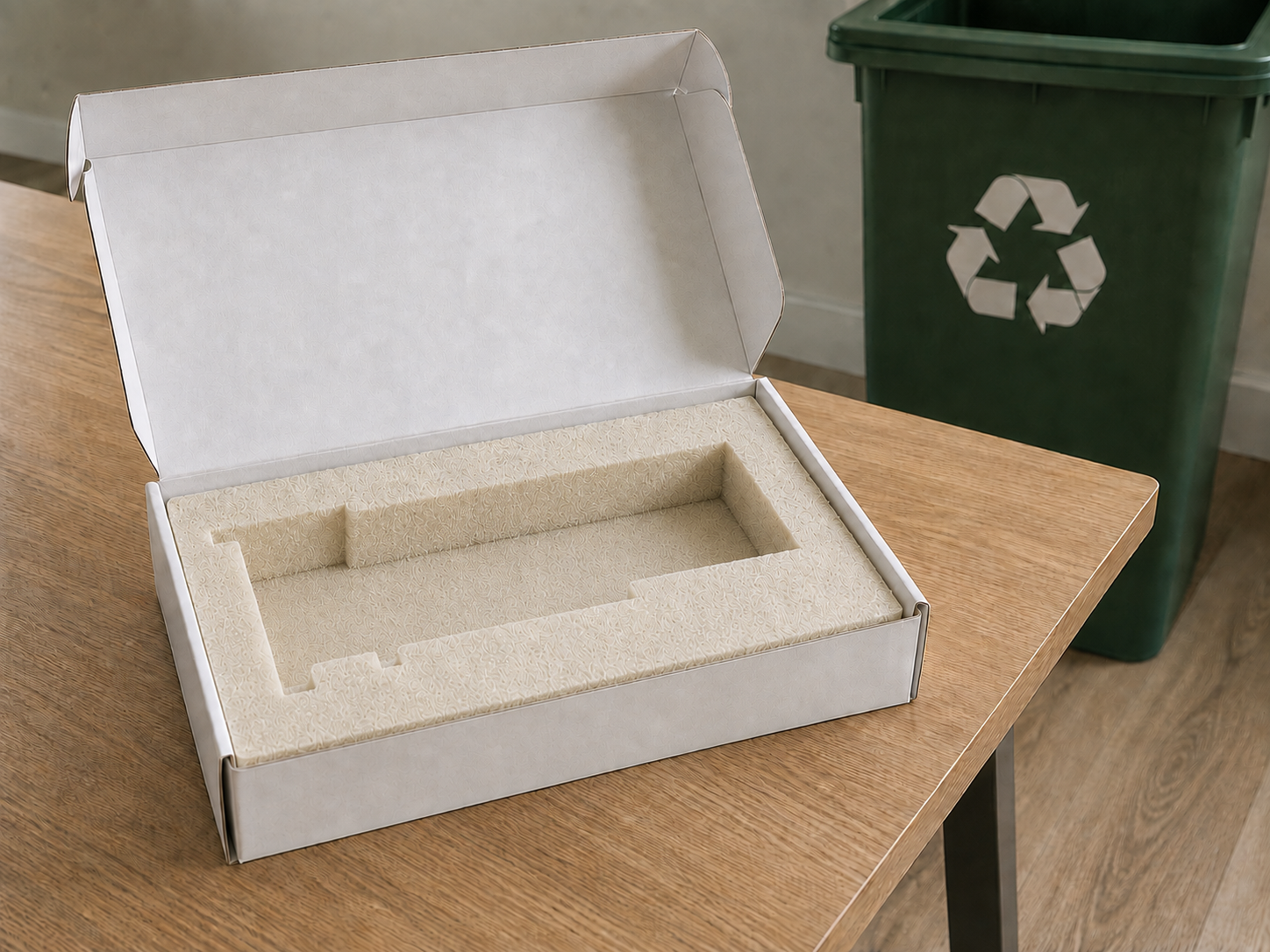
Corrugated box + Fibu wood-fiber foam insert

The Fibu insert does not need to be removed from the corrugated box simply to separate the materials before recycling. The box and cushioning can remain together and enter the paper and board recycling route, where accepted by the local collection and recycling system.

The recycling pathway can therefore become:

Corrugated box + Fibu insert → repulping → fiber recovery → new paper or board

This can simplify disposal for the person opening the package and reduce the need to separate a fiber-based box from a plastic-foam insert.

The same principle can extend to the rest of the package. A corrugated outer box, wood-fiber foam cushioning and paper-based documentation or accessory packaging can all be designed around a common fiber-recycling route.

Real-world recycling still depends on the complete packaging design and on the collection system where the package is discarded.

What to do after unpacking: Where locally accepted, the Fibu insert can remain with the corrugated box and enter the paper and board recycling stream together. Always follow local recycling instructions.

Recycling can further improve the carbon footprint

RISE Research Institutes of Sweden assessed the carbon footprint of Fibu foam and compared it with conventional fossil-based packaging materials.

When recovery benefits at end of life were included, Fibu’s calculated carbon footprint was reduced by approximately 50% compared with the scenario without those recovery benefits.

Compared with the reference materials, the modeled climate savings increased from approximately:

      • 60% to 70% lower than HDPE
      • 70% to 90% lower than EPS

when recovery benefits were included. This shows that recovering value from the material at end of life can further improve Fibu’s environmental performance.

From protective packaging back to raw material

Protective packaging must first do its job: protect the product during transport. But what happens after unpacking also matters.

With conventional plastic foams such as EPS, EPE or PU, the cushioning and corrugated box generally enter different material systems. With Fibu wood fiber foam, the box and protective insert can stay together after unpacking and return to the fiber cycle together.

The package protects the product on its first journey. Its fibers can then begin another one.